Alnwick
Pronounced Ann-ick
Alnwick
is a fine historic Border town which has much to offer. It is set against
a backcloth of the magnificent Alnwick Castle on the banks of the lovely
River Aln about five miles from the sea.
Midway between Newcastle and Berwick on Tweed, Alnwick was about a day's coach ride from either and so became an important staging post providing inns for the travellers.
Bordering the cobbled square are 18th century buildings and the remains of coaching inns.
At the back of one of the inns. White Swan, is the remarkable Olympic Room, created with materials salvaged from the Titanic’s sister ship, which was broken up on the River Tyne in 1935.
In the centre of the square is the Shambles. Animals were once slaughtered here.
The nearby arcades housed stalls looking out into the market from which goods
of all sorts were sold.
A medieval fair is held here for a week beginning on the last Sunday in June.
A stroll around
Alnwick can be very rewarding, there is so of much of historic interest.
Take a walk along Bailiffgate, the oldest street in Alnwick and see the imposing Georgian and Victorian houses built by affluent
merchants.
Wander around the narrow streets off the cobbled square.
Royal proclamations were read from the Market Cross
and a market has been held in Alnwick for 800 years.
When peace came to the Borders, Alnwick developed to the east and to the south. Much of the old walls and towers were dismantled for use as building stone
Alnwick is also within reach of Flodden Battlefield and the battle sites of Homildon Hill and Otterburn.
On entering Alnwick from the south you will pass through the narrow arch of the Hotspur Tower, part of the town walls of which little now remains.
|
|
The Hotspur Tower |

|
|
In the 1980s the whole statue was plunged into the river when a truck crashed into the bridge. On one occasion a boy sat on the lion's tail and the tail snapped off. Both the tail and the boy fell into the river below.
|
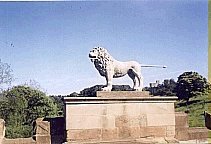
Hulne Park is a large area of natural woodland just north-west of Alnwick Castle. It is open to the public through the generosity of the Duke of Northumberland.
Here you will find peace, quiet and wildlife. There is parking alongside the lodge.
Within the grounds are the remains of 13th century Hulne Priory and Brizlee Tower, an 18th century lookout tower. There are many other attractive features nearby, including the remains of Alnwick Abbey.
Northumberland is reputed to have more castles and towers than any other county in Britain. Many of the castles, and a few of the pele towers, have been restored and are open to the public.
Apart from the site on which they once stood and, perhaps, a few fragments of stonework, little remains of others. Yet a visit can be very rewarding, if only to ponder over their historical past when they were mighty strongholds of note.
Many
of the castles and a selection of pele towers are listed here. They all
have Border family connections and are all worth a visit - if you have
the time, and there are many more waiting for you to discover.
As a bonus, there is the magnificent Northumbrian Coast with its
many attractive coastal villages and long sandy
beaches.
 |
Alnwick Castle
|
Alnwick Castle
Alnwick Castle is a spectacular Border castle dating from the 11th century but, in the course of time, it has suffered from drastic restoration. Yet it is one of the finest examples of a medieval castle.
The castle probably began as a typical motte and bailey structure with a wooded palisade and keep. They were later replaced by a stone keep and a strong defensive wall with corner towers also of stone. It was strong enough to repel attacks by the Scots in 1172 and again in 1174.
In 1309, the Alnwick Castle passed to the Percy family who extended and strengthened
it.
It is still in Percy hands and the castle is the home of the Duke and Duchess of Northumberland.
The Duchess has recently opened a spectacular water garden.
The figures on the battlements are generally thought to be intended to deceive the enemy, but are more likely to be decoration. Similar figures scan be seen on Bothal Castle, to the east of Morpeth.
Alnwick Castle is probably the most outstanding castle in the whole of the Borders and one of the top castles in the country. Within, is a superb collection of treasures.
200 paintings to view, lavish furnishings and a vast accumulation of relics.
In the mid-19th century the castle employed a staff of 86 but now there are only 12.
There is limited parking at the Castle but it is only a short walk from Alnwick’s main car park. A wide range of amenities is available at the Castle and guided tours are provided.
The castle and grounds have been the location of many film sets including Harry Potter.
| The Percy family has for centuries been the foremost family in Northumberland. The Percy influence can be seen everywhere. For centuries they were largely responsible for the security and well being of the people of Northumberland and they became very powerful. The castle has been occupied by the Percy family since 1309. It was one of the greatest strongholds of the region providing a garrison, at one time, of 3000 men. |
The most famous Percy, Harry Hotspur, immortalised by William Shakespeare, was so named because of his impulsive nature. He was born in Alnwick Castle on 20 May 1366, and is renowned for his part in the Battle of Otterburn
|
Around and about Alnwick
Alnwick took its defences very seriously. Not only was it enclosed by a strong wall almost all which has now disappeared but there were a number of outlying towers which served as an early warning system and as preliminary defence.
Dunstanburgh Castle
 |
 |
It has always been accepted that Dunstanburgh Castle was built
about 1313 for defence against Scots invaders. However, modern sources
indicate that that may not be the reason for its creation.
It is now believe that the castle was built by Earl Thomas of Lancaster,
then probably the most powerful man in the kingdom next to Edward II,as
an expression of his status and wealth. It is alleged that the site was selected
to provide dramatic effect surpassing that of Bamburgh Castle further up
the coast.
This imposing castle ruin stands high on an outcrop of the Great Whin
Sill overlooking the sea.
This 14th century castle has had a chequered life between periods of
intense action and periods of neglect and decline. It passed through
many hands before eventually being acquired by the Grey family.
The largest castle in Northumberland, it is now a ruined shell but
spectacular whether approached from inland or from the coastal footpath
from Craster. This is a delightful walk on deep turf with the sea to the
right and the dramatic outline of Dunstanburgh ahead.
The gatehouse and curtain wall are quite magnificent. Note the weather
beaten stonework which has produced some quite remarkable patterns. Look
out for mason's marks.
Dunstanburgh Castle is said to be haunted by the Earl of Lancaster who
was executed for being on the wrong side.
The castle was used as a film set for Mel Gibson’s Hamlet.
Take
the B1339 from Alnwick and walk from Craster along the coastal footpath,
or walk from Embleton.
The coastal walk from Craster to Dunstanburgh is easy and particularly
attractive
Further north is Preston Tower.
 |
Preston Tower The tower stands in a beautiful setting. Much of it has been carefully restored and the interior Is open to visitors. |
This
pele tower was built in 1392 by Robert Harbottle.
It was originally a hall tower with four corner turrets.
Parts of the connecting wall between the two south turrets still
remains.
The tower is three stories high and has the typical vaulted rooms. Two of the rooms are furnished in the style of the period and provided a realistic picture of life in a pele tower.
It is associated with the surname Preston.
|
In
1415, it was recorded that there were no less than 78 pele towers in the
region. |
When peace came to the Borders it looked as it Preston Tower was going to share the fate of so many others. Two of the original four towers were dismantled to provide building material for the nearby cottages. |
|
High up in the tower a water tank was installed to provide water for the nearby inhabitants |
There is a prison on the ground floor and many interesting and informative displays elsewhere, including a particularly interesting Flodden Room. |
Location
The tower lies to the east of the A1, take the B1340 and is
9 miles from Alnwick. It is sign posted.
|
Edlingham Castle William de Felton acquired the hall house of Edlingham in 1294. He strove to make it a strong defensive site and had strong ramparts constructed, the gatehouse built, other buildings added and the hall strengthened until it could be classed as a fortified manor house. A tower house was added in the 15th century. It had very strong walls and the ground floor had a vaulted room. Above were two additional floors and a turret. George Swinburne acquired the property in 1514 and it remained in the hands of the Swinburne family until the 18th century. The ruins make a memorable picture, framed as they are by a high viaduct, a relic of the Alnwick to Cornhill railway which closed in 1935. Close by is the ancient Edlingham Church which is of great interest. The site of the castle does not seem to be strong but it was formerly encircled by a barmkin which was further strengthened by a water filled ditch. The castle began as a fortified manor house of which the tower is only one part, The stronghold was later strengthened by a stone curtain wall and gatehouse. Delete? Family association: the Swinburnes.
Location The impressive railway viaduct to the north east of the castle was built in 1885.
Edlingham Church |

It is a 14th century Norman building and probably served as a local jail as well as a refuge in times of danger from the marauding Scots. The church is as bleak as the surrounding hills. The inside is spacious and quite plain. The tower is not accessible. Across this very porch would have swaggered Thomas Swinburne of Edlingham Castle arrayed in his "velvett cote and satin doublet, both lade with silver lace, his velvett slyvers also trimmed with sylver lace" followed by the good people of Edlingham village in the best clothes they could afford seeking solace and hope and a little relief from the burdens of a life of hardship and poverty. |
